
Threshold


William Bridges began his career as a literature professor. When he turned his attention to transitions, he brought a humanist’s patience for ambiguity and a resistance to premature resolution. His 1980 book Transitions: Making Sense of Life’s Changes has endured because it names something most people have felt without being able to articulate.
His central distinction is between change and transition. Change is external and situational. Transition is what happens inside you in response. It is slower, less linear, and far less amenable to planning. And this internal process always follows the same counterintuitive sequence: it begins with an ending.
Something must be relinquished before something new can take root. After the ending comes what Bridges called the neutral zone, a disorienting stretch where the old is gone and the new has not yet arrived. It can feel like stagnation. Bridges insisted it was generative, a period of psychological gestation where nothing is yet fixed. Only after this phase is genuinely inhabited, rather than merely endured, can a new beginning take hold.
What is striking is how many different traditions arrived at essentially the same structure by entirely different routes.
The anthropologist Arnold van Gennep had mapped it decades earlier in The Rites of Passage (1909), identifying three stages in every significant life transition: separation, liminality, and incorporation. The middle phase takes its name from the Latin limen, meaning threshold. Van Gennep was describing ritual ceremonies, but the structure transfers: people in transition are people on thresholds, suspended between what was and what has not yet formed.
The philosopher L.A. Paul adds a further complication. In Transformative Experience (2014), she argues that certain life changes are epistemically irreducible. You cannot know what it will be like to undergo them from the outside, because the person who emerges will have different values and perceptions than the person who entered. The neutral zone is genuinely unknowable in advance, and no amount of preparation addresses that.
According to Martin Heidegger’s concept of Angst, when ordinary routine dissolves, we are left exposed to what he called the groundlessness of existence. The world of familiar purposes falls away, a moment in which authentic existence became possible precisely because the habitual structures that usually concealed it had given way.
St John of the Cross described the dark night of the soul (noche oscura del alma) as a necessary emptying before transformation.
Jung framed psychological development as a recurring process of ego death and renewal. What looked like collapse was often the precondition of growth.
Buddhist teaching frames the problem differently. The suffering of transition lies less in the transition itself than in the clinging, the resistance to impermanence that is already underway whether we accept it or not. Pema Chödrön suggests that the discomfort of the in-between is not an obstacle to the practice. It is the practice.
The poet Jane Hirshfield extends this further. She describes liminality as something that can become a permanent orientation rather than a phase to be crossed. For most people the liminal is entered and exited. For some it becomes the primary condition of their lives, a sustained openness to what has not yet resolved.
The English Romantic poet John Keats named a related capacity: negative capability. This is the ability to remain in uncertainty without grasping for resolution. He admired it as a mark of creative and intellectual maturity, and connected it specifically to Shakespeare. It is worth noticing that Keats died at twenty-five. Whatever he understood about sitting with the unresolved, he arrived at it young and under pressure.
Nick Cave, reflecting on grief after the death of his son Arthur, offered something rawer. In the Red Hand Files, he described how sudden loss makes ordinary things take on an added intensity, a heightened presence that coexists with devastation.
The British-Indian essayist Pico Iyer has written about impermanence as precisely what confers preciousness on things. In The Art of Stillness and elsewhere, he argues that the value of an experience is inseparable from its transience. Autumn, which we are now moving through here in Australia, makes that visible. The leaves are going. That is why you look at them.
T. S. Eliot circled this idea across the whole of Four Quartets. The lines from “East Coker” are the most direct:
in order to arrive at what you do not know, you must go by the way of ignorance; in order to possess what you do not possess, you must go by the way of dispossession.
There is one more voice worth including, perhaps the least expected.
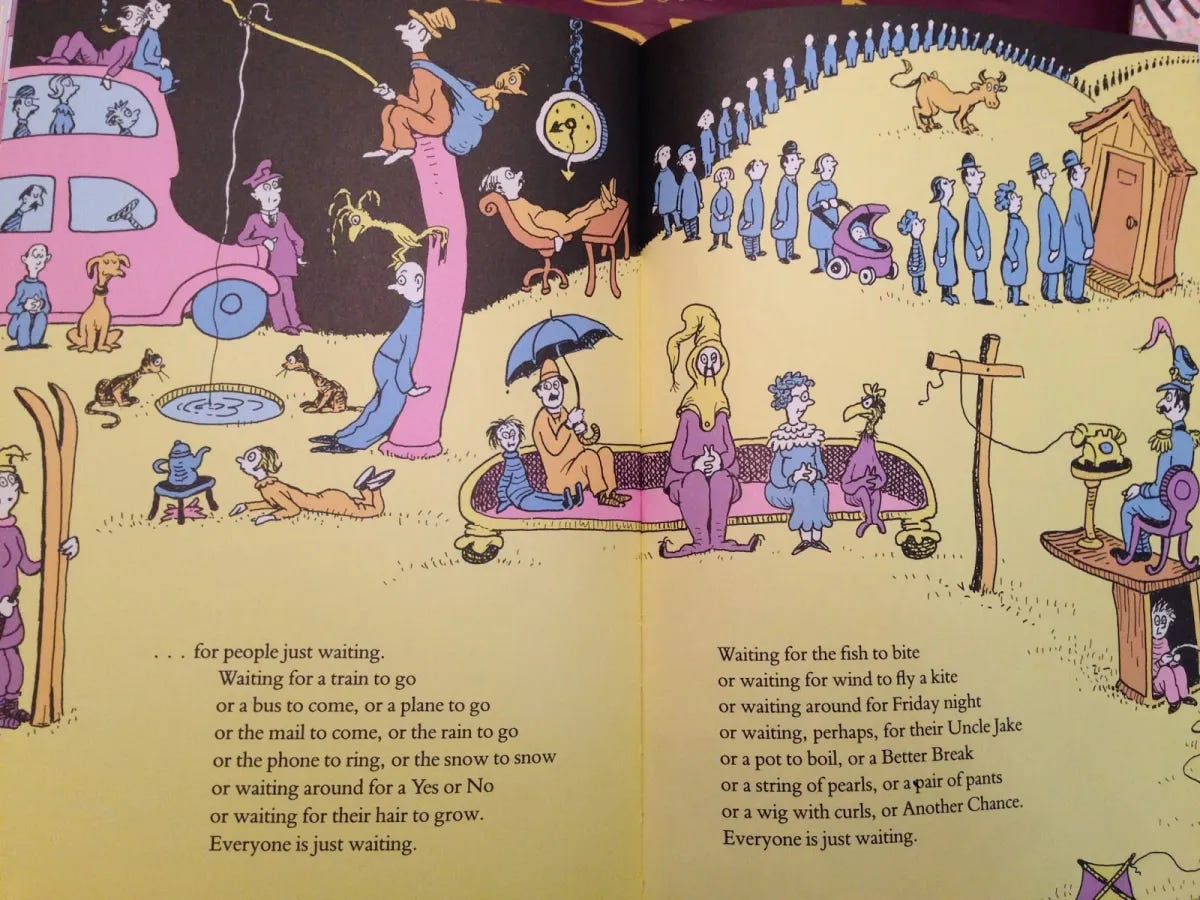
In Oh, the Places You’ll Go!, published in 1990, Dr Seuss devotes several pages to what he calls the Waiting Place. Everyone there is just waiting: for a train, for the rain, for a yes or a no, for their hair to grow. The list accumulates into something genuinely melancholy. Then Seuss tells the reader to escape it.
Seuss was writing for children, and possibly for himself. He was in his mid-eighties, unwell, and the book reads in places like a farewell. The cultural instruction embedded in those pages is one most of us absorbed early: the waiting place is something to be got through, a failure of momentum rather than a necessary condition.
What Bridges, Hirshfield, Chödrön, Keats, and the others suggest is something harder to hold. The neutral zone is not useless. The dark night is not a detour. The threshold is not an obstacle to be crossed as quickly as possible.
These traditions, arriving from different centuries and entirely different concerns, keep returning to the idea that the space between endings and beginnings is where the actual work of transformation happens, and that leaving it before it has done its work is its own kind of loss.
Thank you. This is refreshing and timely. Realising that it isn't about getting through it but being in it... fully.
The winding curved road rather than the sharp edged turn reveals a path not a pivot. Decompression has its own invited insights whereas sharp turns can be blind sight.